
Qubit perspective
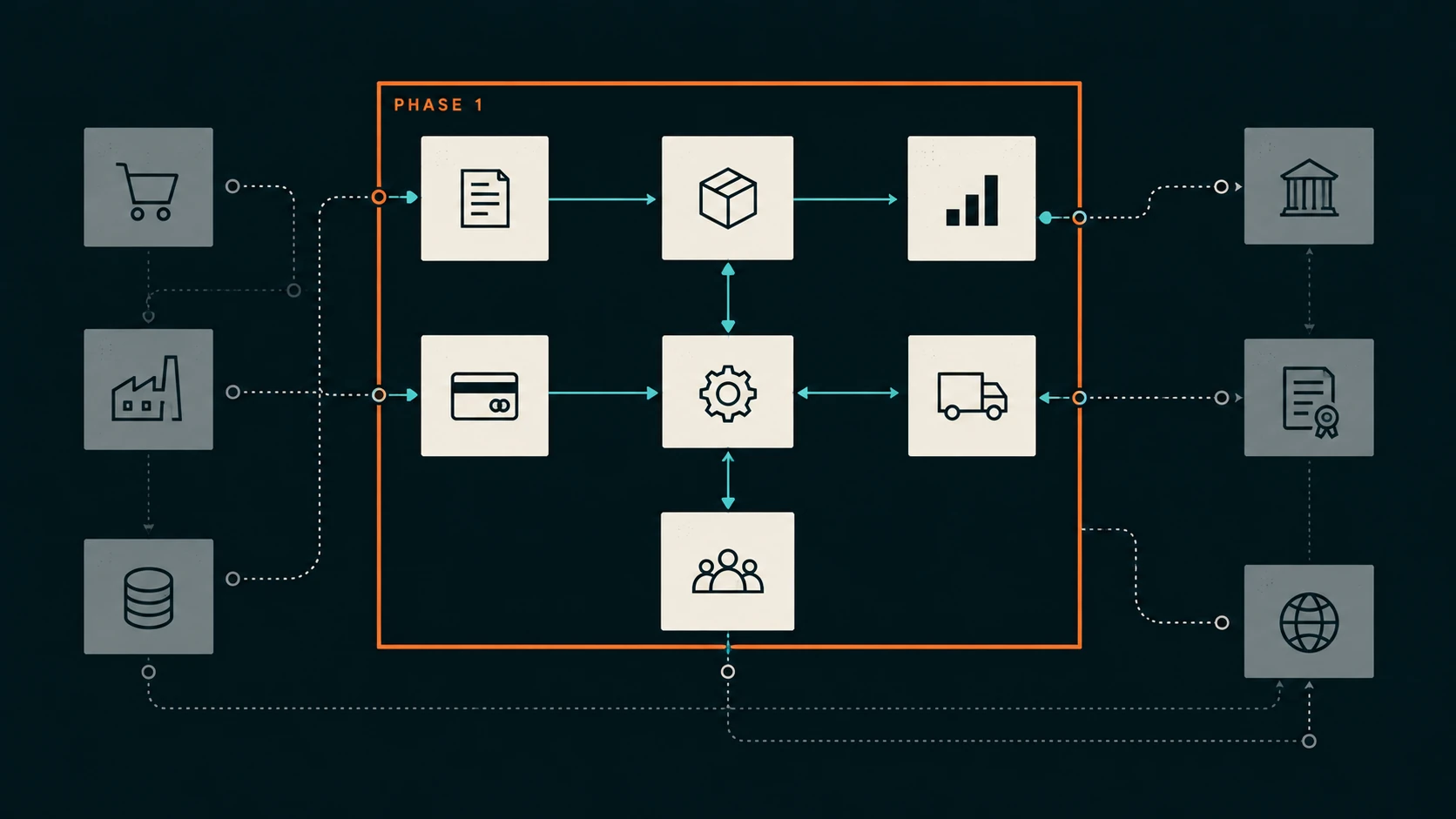
ERP projects often become difficult before configuration starts. Every department has a sensible request, every request sounds important, and “phase one” gradually becomes another name for everything.
That creates a false choice: either accept an overfilled first release or defer so much that the new system delivers little practical value.
A better phase one is not the smallest possible system. It is the smallest coherent operating model that lets the business complete its most important work safely from end to end.
Start with what must work
Do not begin with a list of modules. Begin with a business outcome that must be dependable on the first day of live operation.
For a distributor, that might be receiving an order, checking availability, dispatching goods, raising the invoice and updating the financial position. For a professional-services firm, it might be agreeing work, allocating people, recording time, billing the client and understanding project margin.
Write the outcome in plain language. Name the users, decisions and controls involved. Then ask what would prevent the business from completing that chain without returning to the old system or creating a new spreadsheet workaround.
Microsoft’s current Dynamics 365 implementation guidance recommends using end-to-end business processes to define scope because they show the connections between roles, functions, data and systems more clearly than a disconnected requirements list.[1] The principle applies beyond one platform: scope around the work the business must complete, not the software menu.
Separate essential, dependent and valuable
Once the core process is visible, classify each requested capability.
Essential means the process cannot operate safely or meet a necessary control without it. Dependent means it is required because another essential element relies on it. Valuable means it improves the experience or creates a benefit, but the process can operate without it for a defined period.
This distinction is more useful than asking whether a feature is “important”. Many features are important. Fewer are necessary for the first coherent release.
Dependencies can change the answer. A seemingly small reporting request may require new dimensions, cleaner master data and an integration. A simple approval may affect roles, notifications, audit history and exception handling. Put the dependency beside the request so the decision includes the real effort and risk.
Include the work around the software
Phase-one scope is incomplete if it lists functions but ignores the conditions needed to run them.
For every included process, identify the data to migrate, interfaces to establish, reports needed for operational decisions, permissions and controls, test scenarios, user training, cutover tasks and early support ownership.
These are not project administration added after the “real” scope. They are part of the usable solution. Microsoft’s solution-blueprint guidance treats data, integrations, security, testing, analytics and project responsibilities as early design inputs, helping teams identify gaps before they become larger delivery problems.[2]
If a capability cannot be tested, adopted and supported within the first-release plan, it is not genuinely in phase one.
Test the awkward cases
A happy-path demonstration can make an incomplete scope look convincing. Use real exceptions to test the boundary.
What happens when an order changes after approval? Can a credit be raised and reconciled? How is a duplicate customer handled? Who resolves an integration failure? Can finance close the period when a transaction is disputed? What happens when the person with approval authority is away?
Choose a small set of awkward but common scenarios and trace them across people, process, data and systems. If the proposed scope breaks at the exception, decide whether the missing capability belongs in phase one, the process needs to change, or a controlled temporary procedure is acceptable.
Document any temporary procedure with an owner and an end date. Otherwise, a short-term workaround can quietly become the operating model.
Make deferral a managed decision
“Later” is not a plan. For every deferred item, record why it is outside phase one, what dependency or evidence would bring it forward, and which outcome it should improve.
Group deferred work into sensible releases rather than an unprioritised backlog. The next phase might focus on supplier collaboration, more advanced planning, customer self-service or management reporting. Each should have a clear reason to exist.
This also makes stakeholder conversations more honest. A request is not being dismissed; it is being placed in a sequence that protects the first release and preserves the intended value.
Set evidence for the go-live decision
Agree how the business will know phase one is ready. Evidence might include completed end-to-end tests, reconciled opening balances, trained role owners, successful cutover rehearsals, agreed support routes and signed decisions on remaining risks.
A percentage-complete report is not enough. The important question is whether the business can perform the included processes with acceptable control, confidence and recovery options.
When phase one is framed this way, scope becomes a commercial and operational decision rather than a competition between departmental wish lists. The project can start focused without leaving critical work disconnected.
Discuss your ERP requirements
If you need to turn a broad ERP wish list into a coherent first release, discuss your ERP & CRM requirements with Qubit. We can start with the business process, the outcome it must support and the evidence needed for a safe go-live.
References
Primary Microsoft documentation checked on 12 October 2026. It supports the two specific implementation-practice statements. The prioritisation model and article recommendations are original editorial guidance, not claims of Qubit customer results or guarantees.
- Microsoft Dynamics 365 guidance: Base the implementation lifecycle on your business processes. Dated 3 February 2026. Describes process-led scope, dependencies, design, testing, cutover and support.
- Microsoft Learn: Solution blueprint review with FastTrack for Dynamics 365. Updated 3 October 2025. Lists early solution inputs including data, integrations, security, testing, analytics and responsibilities.